Owl symbolism: Athena, Minerva and the owl of wisdom
In ancient Greece the little owl was the companion of Athena, goddess of wisdom and patron of Athens. Athenian silver coins, the tetradrachms of the fifth century BC, carried Athena’s head on one side and her owl on the other. The Romans identified Athena with Minerva, and the owl passed with her into Roman culture and later European art as a sign of learning and insight.
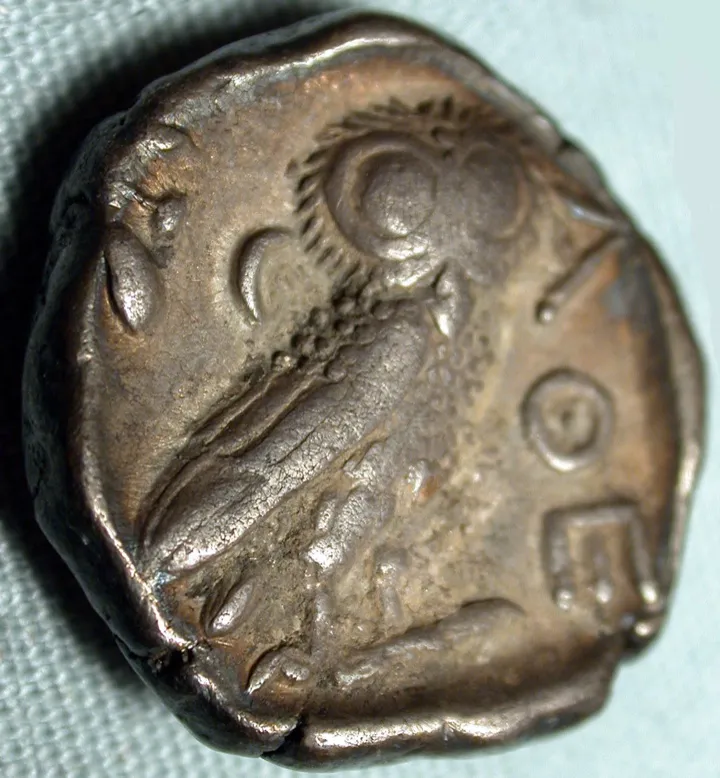 Athenian silver tetradrachm, about 440–404 BC, owl side. The Metropolitan Museum of Art, 2021.40.80, public domain.
The bond was close enough to survive in language. The little owl’s scientific name is still Athene noctua. In Aristophanes’ comedy The Birds (414 BC), “bringing owls to Athens” means doing something pointless, because the city was already full of owls on its coins and its monuments.
The Bavarian Illuminati owl
The Bavarian Illuminati adopted the owl of Minerva as the emblem of its Minerval grade, an early stage of membership devoted to study. Members at this level were called Minervals. The choice suited an order that saw itself as a school of enlightenment. A commonly reproduced emblem shows an owl perched on an open book.
According to historians of the order, Minervals met in small groups under a superior. They read assigned texts, wrote essays and sent regular confidential reports on their progress up the order’s hierarchy.
The owl fitted the order’s wider classical code. Members took ancient names, and the order gave its towns Greek names too: Ingolstadt, where it was founded, was “Eleusis”, the site of the ancient mysteries, and Munich was “Athens”, Athena’s city.
See The Illuminati Secret Society for the order’s other documented traditions.
The owl in philosophy
In 1820 the German philosopher G. W. F. Hegel wrote that “the owl of Minerva spreads its wings only with the falling of dusk”. He meant that wisdom about an age arrives only when that age is ending. The phrase made the owl a lasting image of reflection and understanding.
Modern associations
Today the owl appears in the logos of universities, libraries and publishers, always with the same ancient meaning of wisdom. Claims that owls hidden in designs or banknotes are secret signals have no documented basis.
In short: an ancient symbol of wisdom, and the only one here with a documented historical use by the Bavarian Illuminati.
Related: The Light · History of the Illuminati · Illuminati symbols
Sources
- Richard van Dülmen, Der Geheimbund der Illuminaten (Stuttgart: Frommann-Holzboog, 1975), on the Minerval grade and the order’s code names.
- G. W. F. Hegel, Grundlinien der Philosophie des Rechts (Elements of the Philosophy of Right, 1820), Preface.
- Colin M. Kraay, Archaic and Classical Greek Coins (London: Methuen, 1976), on the Athenian owl tetradrachm.
- Aristophanes, The Birds (414 BC), line 301.